
Dealer’s Choice Tonpuu
This is the Dealer’s Choice Tonpuu ruleset from CY, inspired by the original Jewel League [1] [2] in Japan. It’s a 4-player shuugi riichi mahjong ruleset.
Overall Rules
These are the rules that commonly affect gameplay.
- Starting points: 25,000
- Strict Tonpuusen: East-only and no South extension.
- Placement-only battle: if on, raw points do not influence post-game exchanges (i.e., results are dictated by oka+uma only)
- Ari-ari: kuitan and atozuke are on.
- Abortive draws are on.
- Kiriage Mangan is on.
- Agariyame and tenpaiyame are on for every dealership unconditionally.
- I.e., any dealer can choose to pass after winning/being tenpai at draw, without being the last dealer, and without being in first place.
- Passing resets the honba count.
- Tonshaaba:
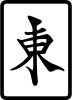
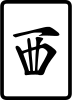 are both round winds.
 - Called Game at 55,000 pt: any player reaching 55,000 pt ends the game instantly and receives 1 chip from each other player.
- All kan dora are revealed immediately.
- Riichi with no draws left is allowed.
- Basengo: honba bonus is 500 per player.
-
Riichi with less than 1000 points is allowed, but you must win the hand or you tobi (ryukoku also counts as tobi)
- Special Tiles:
- 1 purple
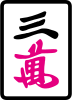
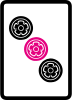
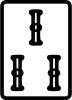 : +1 han and +1 shuugi
 - 1 blue
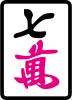
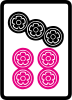
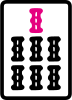 : +1 han and +1 shuugi
 - 1 gold
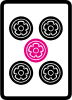 : +1 shuugi
 - 1 platinum
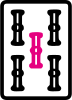 : +1 shuugi
 - 1 cyan
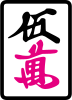 : +1 shuugi
 - 1
 pocchi and 1
 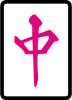 pocchi: both are wildcards if drawn after riichi; also gives +1 shuugi (whether used as wildcard or not)
- discarding pocchi during riichi is not allowed: a player must either call tsumo or kan after drawing pocchi.
- if discarded by mistake, the player must take the tile back and make a valid decision (no penalty).
- discarding
- 1
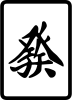 pocchi: wildcard if drawn while tenpai with open hand; also gives +1 shuugi (whether used as wildcard or not)
- a discarded pocchi counts only against furiten.
- a discarded
- 1 purple
Abilities Catalog
Choose 3 abilities to assign to the gold , platinum and cyan . You can also assign abilities to the purple , blue and pocchi tiles.
- Ura-dora kaiji:
- When you win with this tile, flip the ura-dora even if you are not in riichi
- Han o tsukeru:
- Grants 1 dora when your winning hand is strictly less than mangan (4 han 30 or equivalent), or a bump to the next multiple of mangan at the lowest han otherwise (e.g. mangan -> 6 han haneman, haneman -> 8 han baiman etc.)
- Chippu Zoka:
- Grants x1.5 shuugi to your winning hand, rounded up
- Agari han-su o chippu ni kasan:
- Grants +X shuugi where X = number of han of your winning hand
- Yaku-ka:
- Grants 1 han yaku and 1 chip
- Naki Menzen:
- When this tile is a part of your hand, you are eligible for closed yakus even with an open hand
- This includes being able to riichi even with an open hand, but not immediately after making a call
- Called Sananko / Suuanko do not exist under this rule
- Tako Riichi:
- When you riichi with this tile in hand, reveal this tile from your hand and immediately reveal ura-dora
- You may draw and discard twice during a single tsumo turn, sequentially. Ippatsu can only be applied to the first draw
- You cannot open riichi if you choose to double draw
- Kokan:
- Choose either:
- -1 han +3 chips, or
- -1 chip +3 han
- Choose either:
Suggested Configurations:
- Han o tsukeru + Chippu Zoka + Agari han-su o chippu ni kasan
- Naki Menzen + Tako Riichi + Kokan (fan favourite)
- Ura-dora kaiji + Yaku-ka + Naki Menzen
Order of Operations
When counting final hand value/score and shuugi to be awarded, you would generally resolve all hand han value first, then assign chips to tiles, before determining the final chip count of the hand
Example 1: I win a 2han 40fu, 1 shuugi hand with all 3 special tiles.
- Han o tsukeru bumps it up to 3han 40fu
- Agari han-su o chippu ni kasan increases the number of shuugi from 1 -> 4
- Chippu Zoka further increases the number of shuugi from 4 -> 6
Example 2: I win a 4han 30fu, 3 shuugi hand with all 3 special tiles.
- Han o tsukeru bumps it up to 6han 30fu
- Agari han-su o chippu ni kasan increases the number of shuugi from 3 -> 9
- Chippu Zoka further increases the number of shuugi from 9 -> 13.5 ~= 14
Yaku Changes
- Open Riichi is on. Reveal the entire hand.
- Kansai Chiitoi is on and gives extra value based on the number of quads (2 of the same pairs):
- 1 quad: +1 han
- 2 quads: +3 han
- 3 quads: yakuman
- Nagashimangan is a special win that is worth haneman.
- this means honba, etc. are applicable to a nagashimangan win.
- Regarding yakuman:
- kokushi can ron off ankan
- yakuman may stack (except with kazoe yakuman)
- 13-sided kokushi, 9-sided chuuren, daisuushi, suuanko tanki, and suukantsu are double yakuman
- Suukantsu can now be won in a special way, right after calling the 4th kan and drawing the final rinshan tile:
- if the rinshan tile completes the hand, the win is resolved normally (where suukantsu is a yaku, not a special win)
- if the rinshan tile does not complete the hand, then the win is resolved as a special double yakuman that does not stack with anything else. I.e., the winner gets no chips from color tiles, cannot stack other yakuman, etc. This is similar to nagashimangan ruling.
- if the 4th kan was ankan or kakan: this is a special double yakuman tsumo
- if the 4th kan was a daiminkan: this is a special double yakuman ron dealt in by the player who contributed to the daiminkan (this is not tsumo pao, so it’s only 20 chips)
- the player may choose to not win and continue the game
- Note that the suukaikan abort is disabled when all kans are made by the same player, so the game can continue
- the following local yakuman are on and are each a single yakuman
- Shiisanpuutaa/Shiisuupuutaa
- Renhou
- 3-quad kansai chiitoi
- Regarding pao:
- pao is on for daisangen, daisuushi, suukantsu, and rinshan (in the case of rinshan, pao pays the full amount).
- pao is responsible for covering the full shuugi amount (i.e., pays 3x shuugi in the case of tsumo)
Shuugi
Each shuugi chip is worth 5,000 points.
- besides the special tiles, each of ippatsu and ura is worth 1 chip.
- Yakuman shuugi is 20 chips if ron, and 10 chips each if tsumo, for each count of yakuman.
- Kazoe yakuman is 10/5
- Tobi: 1 chip
- in the case of multi-ron and multi-tenpai at draw, pay to all players that won/were tenpai.
Oka and Uma
Dynamic Oka (20) and uma (50/20) are paid together in chips:
Placement Points
4th place
- Under 5,000 points -> pay 11 chips
- Under 15,000 -> pay 10 chips
- 15,000 or more -> pay 9 chips
3rd place
- Under 5,000 -> pay 5 chips
- Under 15,000 -> pay 4 chips
- Under 25,000 -> pay 3 chips
- 25,000 or more -> pay 2 chips
2nd place
- 35,000 or more -> receive 4 chips
- 25,000 or more -> receive 3 chips
- 15,000 or more -> receive 2 chips
- 5,000 or more -> receive 1 chip
1st place
Receive the difference from the above amounts.
Alternatively, for a fixed Oka+Uma system:
- 13/3/-5/-11
Penalties
Chonbo penalty is 3000 all.
- false pon, chii, kan, riichi calls that are NOT corrected before the next draw receive are chonbo. (No penalty if corrected)
Dead hand penalty applies to the following scenarios:
- false ron and tsumo calls.
- kuikae
- taahai and shouhai
Optional Rules
- Each shuugi chip is worth 10,000 points instead of 5,000
- Raw points also contribute to post-game exchanges (instead of “placement-only battle”)
- Special abortive draw: before the dealer’s first discard, every player agrees to abort. This abort does not increase honba.
House rules
At my place, I usually play with these modifications/clarifications:
- If you are in riichi, you can peek at adjacent players’ hands (even if you can kan)